Chevin Cross - Health and Safety
 The information below has been prepared to ensure that all volunteers are familiarised with the risks associated with the erection and dismantling of The Chevin Cross, so that the operations can be undertaken in a safe manner. Please read the guidance and complete the simple response form at the bottom of this page.
This information can also be downloaded in printable, PDF format (2 pages) here
RISKS
Following a risk assessment of the procedures for collection, transportation, and erection of the cross, the following are the main risks that are likely to be encountered:
-
Manual handling: Injury due to attempting to lift heavy objects.
-
Manual handling: Injury due to trapped fingers or toes, cuts & abrasions from wood/metal.
-
Slips, trips, and falls due to lifting heavy objects and working on uneven surfaces.
-
Injury due to lack of clarity of working instructions during the erection/dismantling process
-
Injury due to weather conditions, either increasing the risk during erection and dismantling, or causing exposure because of the position on the hillside where the cross is erected.
-
Injury to the public during the period that the cross is in position e.g. by tripping/impacting on supporting guy wires; or from any part of the structure becoming loose or break.
General steps to obviate risks:
The transportation of the cross structural members is undertaken by a road haulage company, R & C Cooper Transport and is covered by their own Health & Safety Policy. Their driver is also a qualified fork lift truck operator. The structure is stored at Sinclair’s warehouse and its storage and movement on that site is covered by their company’s Health & Safety Policy.
Prior to the Cross being erected or dismantled:
The Chevin Cross Co-ordinator and team will agree:-
-
The scope for mechanical assistance during the handling processes – and any associated risks.
-
Confirm any such mechanical assistance is available and fit for purpose
-
Ensure that all structural members, associated guy wires, other supprting materials and equipment are in a sound condition
-
Ensure that all volunteers are acquainted with this Health & Safety policy,
-
That weather conditions are not such that the operation should be postponed
-
The minimum number of volunteers required for the task are available.
-
Arrangements for regular inspections during the period the cross is raised.
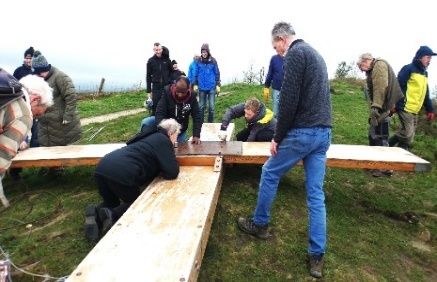 In view of an incident in 2025 when a fit elderly volunteer was injured, discussions have taken place about limiting the age of volunteers. After due consideration it is felt that this decision must be left with the individual volunteers, but all volunteers must be reminded that it is at their own risk that they participate in the operations and no claim can be made against Otley Churches Together.
Volunteers will be directed to these H&S pages when requests are made in notices, letters to churches and the media. Summaries will be posted at the site on the appropriate days and a reminder will be given via the mega-phone before actions begin. Furthermore, an additional anchor point will be concreted into the site in order that a second mechanical winch can be utilised, especially in the lowering process.
Manual Handling
It is not just the weight of a load that causes the risk - any object that is picked up awkwardly can cause an injury. Consideration should therefore be given not only to the handling of the main parts of the cross, i.e. the three main wooden sections, but also other items such as guy-lines, bolts, spanners, toolkits etc.
To lift any load safely, the following guidelines should be followed:
-
Examine the load, ensure it is stable, equally distributed between those carrying it, and does not have any sharp edges.
-
Plan the job, ensuring that the route where the load is being carried is as straight as possible (even if it is slightly longer overall) and is free from slipping and tripping hazards. The unloading area (in our case the lorry) should be clear.
-
Ensure everyone has a firm grip. (One of the most common causes of injury when handling objects is an insecure hold.) Each person should consider in advance how to hold the object and decide whether they need to wear any kind of personal protective equipment such as gloves (see later section for more details on this point).
Slips, Trips and Falls
The top of a hillside, strewn with rocks, tufts of grass etc. is not the smoothest of surfaces on which to work, and the risk therefore of slipping and tripping is quite high. It is essential therefore that risks are minimised by taking the following steps:
-
Footwear needs to be considered carefully and it is recommended that people wear stout shoes or boots with a cleated or strong patterned sole.
-
Cables should be collected up and not allowed to trail from the structure particularly when it is being moved.
-
Ensuring that the load being moved is done at a sensible speed so that nobody is rushing.
Personal Protective Equipment
It is recommended that the following items are either worn or brought for use during the process of erecting the cross:
-
Stout shoes or boots with a cleated or strong patterned sole.
-
Thick gloves both for protection against splinters from wood and metal, and for warmth.
-
Windproof and waterproof clothing, including a thickish jacket. (N.B. the temperature at the top of the Chevin is likely to be 3°F colder than in Otley itself, and there is likely to be a wind chill factor to be taken into account as well.)
-
Warm woollen headgear, again as a protection against the cold.
Instructions and the function of the "Person in Charge"
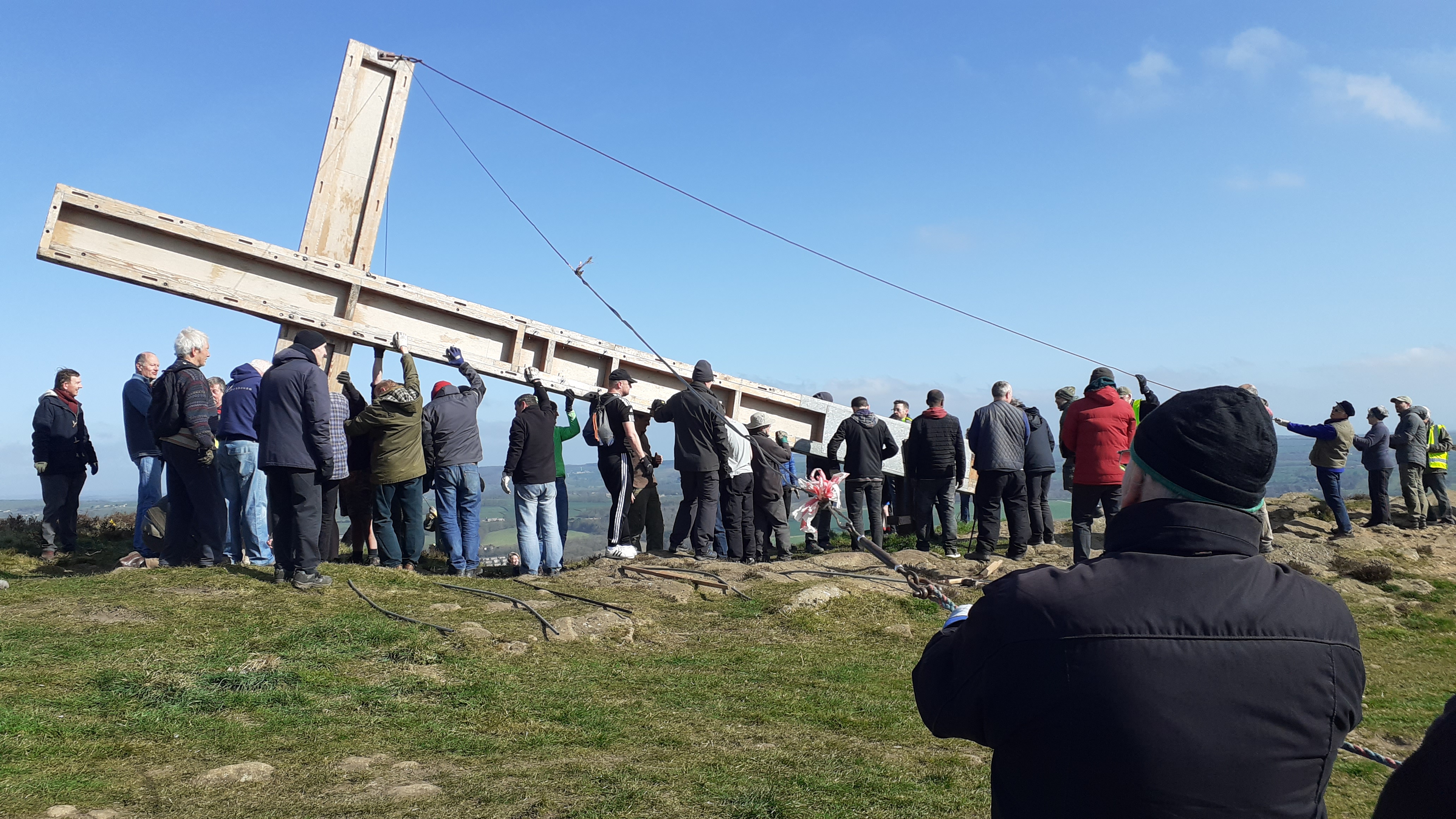 It is important that everyone helping is aware of their role and that all work together as "a team". To this end, it is necessary for there to be a designated "Person in Charge". This individual may alter from year to year so it is important that everyone knows who this is.
Prior to the various parts of the job being undertaken i.e. placing the cross on the transport in the centre of Otley, unloading it at the top of the Chevin, carrying it to the erection site and the erection itself; the person in charge will issue instructions to those people involved in the task concerned.
This will be done verbally and it is important that however many times in the past you have been involved with the erection/dismantling of the cross, that you listen carefully and do not talk to others whilst these instructions are being given. It is for your safety that this is being done!
Finally, be mindful for your own safety and that of others
If you intend to help with the Chevin Cross being put up or taken down please complete the Volunteer Agreement below:
Revised January 2026 - JDS